Publications Archivum Latinitatis Medii Aevi, 80, 2022-2023
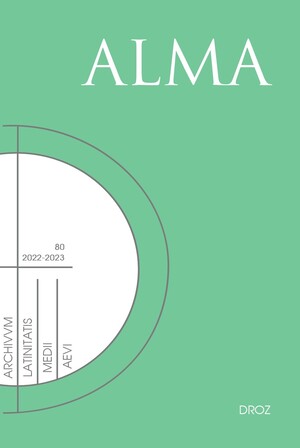
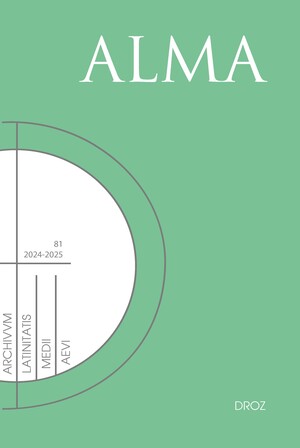
Archivum Latinitatis Medii Aevi, 80, 2022-2023
348 pages.
Pour se procurer ces périodiques :
Librairie Droz, 11 rue Massot Case Postale 389
1211 Genève 12 – Suisse
Tél : +41 22 346 66 66 ; Fax : +41 22 347 23 91
Site : www.droz.org
Courriel : droz@droz.org
Présentation
- Articles
Marina Giani, Gassia inlustris vir. Indagini su un corpus di glosse altomedievali al De civitate Dei di Agostino (I), p. 5-58.
Riassunto. – Nuova edizione critica di un corpus di 266 glosse marginali ai primi dieci libri del De civitate Dei di Agostino. Il testo critico, fondato su sette testimoni altomedievali, è preceduto da un’introduzione filologica, dove – tra le altre cose – è avanzata una nuova proposta di contestualizzazione storica. Chiude il saggio un commento ecdotico e linguistico.
Abstract. – New critical edition of a corpus of 266 marginal glosses to the first ten books of Augustine’s De civitate Dei. The critical text, based on seven early medieval witnesses, is preceded by a philological introduction, which – among other things – presents a new proposal for the historical contextualisation of the corpus. An ecdotic and linguistic commentary concludes the essay.
Walter Berschin, Amarae mortis passivum. Sprachexperimente in der Kölner ottonischen Malerschule um das Jahr 1000, p. 59-75.
Zusammenfassung. – Zwei um 1000 entstandene Prachthandschriften der Kölner ottonischen Malerschule (Paris, Bibliothèque nationale de France, lat. 817 und Darmstadt, Universitäts- und Landesbibliothek, 1640) stellen ihren Bildern aufwendig gestaltete Schrifttafeln gegenüber, deren Texte seltene und z.T. neugebildete Begriffe enthalten. Die bevorzugte Verwendung von Wörtern mit dem Suffix –ivus weist auf ein Studium von Dionysius Areopagita, De caelesti hierarchia in Übersetzung und Kommentar von Iohannes Scottus († um 880) hin, dessen Bildtheologie und Lichtmetaphysik die Tituli der beiden Handschriften reflektieren.
Résumé. – Deux manuscrits de luxe exécutés vers l’an mil dans l’école de peinture de Cologne (Paris, Bibliothèque nationale de France, lat. 817 et Darmstadt, Universitäts- und Landesbibliothek, 1640) présentent en face des miniatures des inscriptions soigneusement élaborées. Elles contiennent des mots rares et partiellement des néologismes. La prédilection pour l’usage de mots avec le suffixe –ivus semble indiquer l’étude du De caelesti hierarchia de Denys l’Aréopagite, traduit et commenté par Jean Scot Érigène († vers 880). Les tituli des deux manuscrits reflètent aussi la théologie de l’image et la métaphysique de la lumière de Denys l’Aréopagite.
Angela Cossu, Juvénal dans deux florilèges du Mont-Cassin du XIe siècle, p. 77-99.
Résumé. – Cet article interroge la tradition textuelle de Juvénal au prisme de deux florilèges cassiniens du XIe siècle : le florilège de Laurent d’Amalfi († 1049), conservé dans le manuscrit Venezia, Biblioteca Nazionale Marciana, Lat. Z 497 (= 1811), et le Lexicon prosodiacum d’Albéric du Mont-Cassin († 1094-1099). Après avoir isolé la lignée de tradition bénéventaine de Juvénal et ses témoins, les citations des deux florilèges sont examinées, afin de vérifier leurs parentés. Les citations de Laurent peuvent bien être reconduites aux témoins bénéventains subsistants et notamment au manuscrit Città del Vaticano, Biblioteca Apostolica Vaticana, Vat. lat. 3286 ; les vers du Lexicon prosodiacum, à placer avec certitude dans la famille Φ des Satires, n’offrent pas, pourtant, de correspondances patentes avec d’autres témoins reconnaissables. Ce fait porte à s’interroger sur les modalités de compilation des florilèges et sur les sources juvénaliennes disponibles dans l’aire d’influence bénéventaine au XIe siècle.
Abstract. – This article interrogates Juvenal’s textual tradition through two 11th– century florilegia of Monte Cassino : the florilegium of Lawrence of Amalfi († 1049), preserved in the manuscript Venezia, Biblioteca Nazionale Marciana, Lat.Z 497 (= 1811), and the Lexicon prosodiacum of Alberic of Monte Cassino († 1094-1099). After isolating the Beneventan tradition of Juvenal and his witnesses, his quotations from the two florilegia are examined, in order to verify their relationship. The text of Lawrence’s florilegium can be traced back to the surviving Beneventan witnesses and in particular to the manuscript Città del Vaticano, Biblioteca Apostolica Vaticana, Vat. lat. 3286; the verses from the Lexicon prosodiacum, which can be placed with certainty in the Φ family of the Satires, do not, however, offer any obvious correspondences with other recognisable witnesses. This fact raises the question of how the florilegia were composed and of which Juvenalian sources were available in the Beneventan area of influence in the 11th century.
Joseph J. Flahive, Mediaeval French Influence on Celtic-Latin Vocabulary, p. 101-135.
Abstract. – This paper examines the lexemes within the Archive of Celtic Latin Literature database that have been assigned Anglo-Norman or Old French etymological comparanda by the Dictionary of Medieval Latin from Celtic Sources. It assays the incidence of these terms, particularly the diachronic development of their geographic spread across the Celtic nations. The relatively few terms attested before ca. 1000 document general trends in which Romance developments influenced mediaeval European Latinity. After 1000, there are borrowed terms from French law and government, and also cultural practices. French usage also influences other Latin lexemes in meaning or form. Special attention is drawn to the vocabulary of the translations of the Welsh Laws of Hywel Dda and to the zoological borrowings and interlinguistic wordplay of Giraldus Kambrensis. Celtic-speaking authors of Latin had a stable, established vocabulary; most preferred to generate vocabulary from within the Latin language itself, though certain normanised elite authors and Hiberno-Latin hagiography after 1100 were more willing to borrow.
Résumé. – Cet article examine les lexèmes dans la base de données Archive of Celtic Latin Literature auxquels le Dictionary of Medieval Latin from Celtic Sources a attribué des comparanda étymologiques anglo-normands ou en ancien français. Il analyse l’incidence de ces termes, en particulier le développement diachronique de leur diffusion géographique à travers les nations celtiques. Les termes relativement peu nombreux attestés avant les environs de l’an mil documentent les tendances générales selon lesquelles les développements romans ont influencé la latinité européenne médié-vale. Après l’an mil, on trouve des termes empruntés au droit et au gouvernement français, ainsi qu’aux pratiques culturelles. L’usage français influence également d’autres lexèmes latins dans leur sens ou leur forme. Une attention particulière est portée au vocabulaire des traductions des lois galloises de Hywel Dda et aux emprunts zoologiques de Giraud le Cambrien ainsi qu’à ses jeux de mots interlinguistiques. Les auteurs de langue celtique qui écrivaient en latin avaient un vocabulaire stable et établi ; la plupart préféraient générer du vocabulaire à partir de la langue latine elle-même, bien que certains auteurs d’élite normannisés et l’hagiographie hiberno-latine après 1100 aient été plus disposés à faire des emprunts.
Renaud Alexandre, Iwona Krawczyk, Krzysztof Nowak, Le Vocabularium Bruxellense : histoire et perspectives d’une publication numérique, p. 137-147.
Résumé. – Le Vocabularium Bruxellense est un glossaire latin médiéval du xiie siècle. Dans le présent article, nous présentons le manuscrit qui porte ce glossaire (Bruxelles, KBR, II 1049) ainsi que l’édition numérique de ce texte, que nous avons élaborée à partir de la transcription effectuée par Harry F. Reijnders.
Abstract. – The Vocabularium Bruxellense is a medieval Latin glossary dating from the 12th century. In this article, we present the manuscript containing this glossary (Bruxelles, KBR, II 1049) as well as the digital edition of this text that we have prepared, based on the transcription carried out by Harry F. Reijnders.
Ombeline Fichant, La place du Vocabularium Bruxellense dans une compilation cistercienne inédite, l’Opusculum de naturis animalium (début XIIIe siècle), p. 149-175.
Résumé. – Composé au début du XIIIe siècle par un compilateur resté anonyme, l’Opusculum de naturis animalium est une œuvre singulière essentiellement consacrée aux animaux, qui allie perception chrétienne de la nature et de la faune, esprit encyclopédique et spiritualité monastique. Cette compilation se distingue notamment par la richesse et la diversité des sources mobilisées pour sa rédaction, qui reflètent la culture et les centres d’intérêt de son auteur, parmi lesquels un goût prononcé pour la grammatica ; en témoignent les contenus rassemblés dans l’Opusculum, ainsi que l’importance accordée aux œuvres lexicologiques et grammaticales citées, au premier rang desquelles le Vocabularium Bruxellense, un lexique latin plutôt rare probablement composé dans la seconde moitié du XIIe siècle. Cet article s’intéresse aux liens qui existent entre ces deux textes, et notamment aux diverses manières dont le compilateur utilise les définitions empruntées au Vocabularium Bruxellense, qu’il s’agisse d’enrichir son discours sur les animaux et les noms qui les désignent, d’évoquer de tout autres sujets, de faire connaître à ses lecteurs des mots intéressants ou de leur transmettre des notions de grammaire.
Abstract. – Written in the early 13th century by a compiler who has remained anonymous, the Opusculum de naturis animalium is a unique work devoted to animals, combining a Christian view of nature and fauna, a somewhat encyclopedic spirit and monastic spirituality. Setting this work apart are the richness and diversity of the sources used to write it, which reflect the culture and interests of its author, including a great interest in grammatica; this is revealed by the contents compiled in the Opusculum and the importance attached to lexical and grammatical texts, beginning with the Vocabularium Bruxellense, a rather unknown Latin dictionary probably written in the second half of the 12th century. This article focuses on the relationship between these two texts and especially on the many ways in which the compiler uses the definitions of the Vocabularium Bruxellense, whether to enrich his discourse on animals and the names given to them, to discuss other subjects, to present interesting words to his readers or to impart grammatical concepts to them.
Elisa Lonati, Comment écrire une compilation sans perdre sa voix : Hélinand de Froidmont, Vincent de Beauvais et Aubri de Trois-Fontaines auctores de leurs œuvres, p. 177-237.
Résumé. – Les intérêts et les compétences d’un compilateur, auteur d’une œuvre « impersonnelle » par définition, se déduisent normalement de la sélection de sources qu’il propose, de la manière dont il réélabore les extraits retenus et de la structure selon laquelle il les organise. Cependant, des historiens et compilateurs comme Hélinand de Froidmont (†1230), Aubri de Trois-Fontaines (†1252) et Vincent de Beauvais (†1264) ont aussi voulu se rendre visibles au sein de leurs œuvres à travers des commentaires sur les sources, des enrichissements et des remarques structurelles habituellement placés sous l’étiquette A(u)ctor. On offre ici une première enquête sur les centaines de prises de parole dont Hélinand a parsemé son Chronicon, en mettant en relief les problématiques variées auxquelles il s’est confronté, les mécanismes par lesquels sa pensée s’est exprimée, et donc les tendances qui furent à la base de la composition de son œuvre. De leur côté, Vincent et Aubri ont repris certaines de ces interventions d’auteur parmi les nombreux matériaux qu’ils ont hérités du Chronicon, mais chacun a mis sous sa responsabilité de nouvelles réflexions et un grand nombre d’informations, dont le rôle dans l’architecture de leurs œuvres respectives mérite d’être approfondi.
Abstract. – The interests and skills of a compiler, author of an intrinsically “impersonal” work, are mainly deduced from the selection of sources he proposes, the way he reworks their extracts and the structure in which he organises them. However, historians and compilers such as Helinand of Froidmont († 1230), Alberic of Trois-Fontaines († 1252) and Vincent of Beauvais († 1264) also wanted to make themselves visible within their works through comments on sources, enrichments and structural remarks usually placed under the label A(u)ctor. We offer here a first overview of the hundreds of direct interventions that punctuate Helinand’s Chronicon, highlighting the different issues he confronted, the mechanisms by which his thought was expressed, and therefore the trends that governed the composition of his work. For their part, Vincent and Alberic took up some of these authorial contributions among the many materials they inherited from the Chronicon, but each of them put under his own responsibility new ideas and a wealth of information, whose role in the architecture of their respective works deserves to be explored.
Alessio Mancini, Vr non bur non bluttaon, p. 239-250.
Riassunto. – Il contributo prende in esame le numerose attestazioni di una formula volta a favorire il parto, aggiungendo alle testimonianze già note quella del manoscritto Sankt Florian, Bibliothek des Augustiner Chorherrenstifts, XI.580. Dopo aver dato conto delle differenze formali tra le sue occorrenze, si tenta una ricostruzione del testo originario della formula: dall’analisi emergono interessanti consonanze lessicali con la terminologia medico-botanica della Tarda Antichità e con Plinio il Vecchio.
Abstract. – The paper examines the several attestations of a charm meant to ease childbirth, adding to the already known evidence that of the manuscript Sankt Florian, Bibliothek des Augustiner Chorherrenstifts, XI.580. After considering the formal differences between its occurrences, a reconstruction of the original text of the charm is attempted: interesting lexical consonances with the botanical-medical terminology of late Antiquity and with Pliny the Elder emerge from the analysis.
Philipp Roelli, Jan Ctibor, A New Version of Corpus Corporum, the Latin Full-Text Database and Tool, p. 251-266.
Abstract. – The article provides background information on the freely accessible online project Corpus Corporum, the largest structured Latin text meta-corpus in existence. A completely reworked version of software and presentation was launched in 2021. The main purpose of the project is to provide readers access to Latin texts, help in perusing them, and in finding passages. The new version is more stable, more easily extendible, and provides a number of new features, some of them still under construction. The project uses exclusively free and open software, most importantly BaseX, TreeTagger, and Sphinx. TEI XML files are used as input, they are automatically PoS-tagged and lemmatised. Users can then read the texts and by clicking words visualise lemma entries in some of the most important Latin dictionaries. The major novelties are: searches that can ignore orthographic and medieval spelling variation, the automatic identification of possible text-reuse, and metrical analyses.
Zusammenfassung. – Der Artikel informiert über das frei zugängliche Online-Projekt Corpus Corporum, das momentan größte strukturierte lateinische Text- Metakorpus. Eine komplett überarbeitete Version von Software und Präsentation wurde 2021 publiziert. Hauptzweck des Projekts ist es, Lesern Zugang zu lateinischen Texten zu bieten, sie bei der Lektüre zu unterstützen und Textstellen zu suchen. Die neue Version ist stabiler, leichter erweiterbar und bietet eine Reihe neuer Funktionen (z.T. noch in Entwicklung). Das Projekt verwendet ausschließlich freie und offene Software, vor allem BaseX, TreeTagger und Sphinx. Texte in TEI XML können geladen werden, sie werden dann automatisch mit PoS-Tags versehen und lemma- tisiert. Benutzer können Texte lesen und dabei auf Wörter klicken, um Lemma- Einträge in einigen der wichtigsten lateinischen Wörterbücher angezeigt zu bekom- men. Die wichtigsten Neuerungen sind Suchfunktionen, die orthographische und mittelalterliche Schreibvarianten ignorieren, sowie die automatische Identifikation von Text-Wiederverwendung und die Analyse von Versen.
Philippe Verkerk, Elaboration of a practical lemmatizer for Latin using Artificial Intelligence, p. 267-294.
Abstract. – I present here a plug-and-play lemmatiser that converts a plain text into an annotated file in LASLA’s standard (APN-file). It is a hybrid code that involves a rule-based decomposition of the forms and an AI-based disambiguation. The AI part derives from Latin-BERT, trained on purpose with the texts annotated at the LASLA. This lemmatiser has been tested on one of the Cicero’s texts annotated by the LASLA and its overall accuracy is 97%, with sub-tasks’ accuracies ranging from 98.5% to 99.4%. It will be soon available for on-line lemmatisation on the Hyperbase web-site.
Résumé. – Je présente ici un lemmatiseur prêt à l’emploi pour convertir un fichier texte en un fichier annoté aux standards du LASLA (fichier APN). Il s’agit d’un code hybride qui associe une décomposition des formes suivant les règles de flexion et une désambiguïsation reposant sur l’intelligence artificielle. La partie IA dérive de Latin-BERT et a été entraînée spécifiquement avec les textes annotés au LASLA. Ce lemmatiseur a été testé sur l’un des textes de Cicéron annotés au LASLA et son efficacité globale est de 97%, avec une précision variant de 98,5% à 99,4% pour chacune des sous-tâches. Il devrait bientôt être disponible pour effectuer une lemmatisation en ligne sur le site web d’Hyperbase.
- Chronique et comptes rendus
Alberto Bartola, Cronaca degli avvenimenti italiani : 2022, p. 295-311.
Elisa Lonati, recension de : Michael D. Reeve, The Transmission of Pliny’s Natural history (2021), p. 312-319.
Silverio Franzoni, recension de : Stephen P. Oakley, Studies in the Transmission of Latin Texts, Volume 1: Quintus Curtius Rufus and Dictys Cretensis (2020), p. 320-328.
Álvaro Cancela Cilleruelo, recension de : De nominibus dubiis cuius generis sint, ed. Elena Spangenberg Yanes (2020), p. 328-332.
Adriano Russo, recension de : Pietro Diacono, Liber illustrium virorum archisterii Casinensis, ed. Mariano Dell’Omo (2022), p. 332-342.
Anne-Marie Turcan-Verkerk, recension de : Guido Faba, Gemma purpurea, ed. Michele Vescovo (2022), p. 342-345.